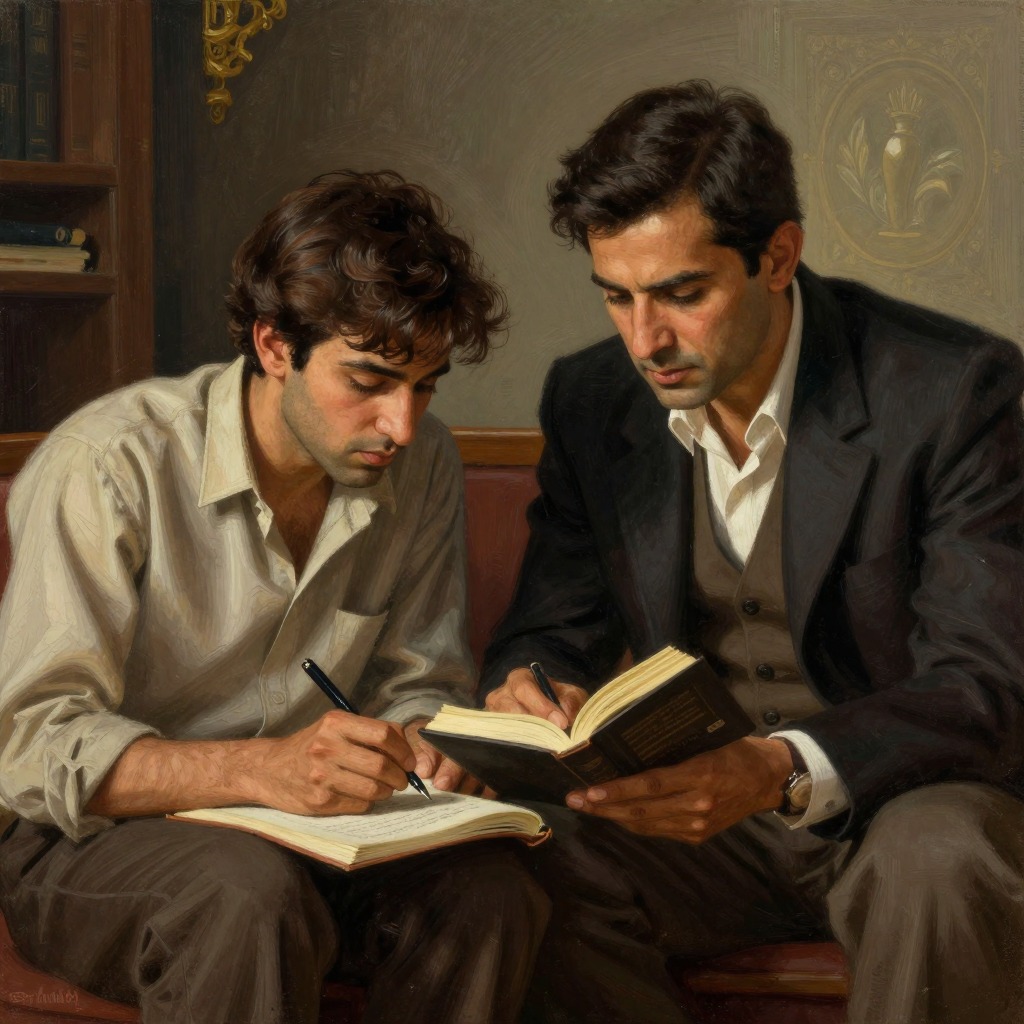
Leather-bound Notebook
The leather-bound notebook, a gift from Rahim Khan to Amir on his thirteenth birthday, is far more than a simple writing implement. It is a vessel for Amir's nascent literary ambitions, a silent witness to his guilt, and a physical thread connecting him to the past he has tried to bury. Its journey through the novel traces the arc of Amir's life, from a hopeful boy in Kabul to a guilt-ridden man in America, and finally to a figure seeking atonement.
Gift and Early Promise
On the night of his thirteenth birthday party, Amir, feeling isolated and burdened by his betrayal of Hassan, slips away from the festivities. Rahim Khan finds him sitting alone in the dark and gives him a brown leather-bound notebook, saying, "For your stories." Amir traces his fingers along the gold-colored stitching on the borders and smells the leather, a moment of genuine connection in a sea of hollow celebration. This gift stands in stark contrast to the other presents he receives, which he considers "blood money" from a party he feels he did not deserve. The notebook is the only gift he does not toss onto the pile of toys in the corner of his room, a testament to its unique significance. It becomes the physical repository for his early attempts at writing, the place where he begins to hone the craft that will define his adult life.
A Link to the Past
Years later, after Baba's death and Amir's marriage to Soraya, the notebook resurfaces. Amir comes home to find Soraya and the ailing Baba engaged in a secret. Soraya has been reading Amir's old stories from the notebook to Baba, a gesture that moves Amir deeply. He recognizes the leather-bound book immediately, tracing his fingers along its gold-stitched borders and remembering the fireworks from the night Rahim Khan had given it to him. This moment reveals that the notebook has traveled with Amir through his exile, a silent companion holding the seeds of his future career as a novelist. It also serves as a bridge between his past and present, connecting his dying father, his supportive wife, and the boy who once dreamed of being a writer.
The Call to Redemption
The notebook's symbolic weight is amplified by its connection to Rahim Khan, the man who gave it to him. When Rahim Khan calls Amir from Pakistan, the call is not just a request to visit a dying friend; it is a summons to confront the past. Rahim Khan's words, "There is a way to be good again," echo in Amir's mind, and the memory of the notebook and the encouragement it represented becomes intertwined with this call to action. The notebook, a gift from the man who always believed in Amir's potential, now stands as a challenge to live up to that belief by facing the consequences of his childhood cowardice. It is a tangible reminder of the person he could become, a person worthy of the faith Rahim Khan placed in him.
A Legacy of Words and Silence
Ultimately, the leather-bound notebook is more than a personal artifact; it is a symbol of the power of stories to connect, to heal, and to pass on a legacy. It holds the first stories of a boy who would become a published novelist, but it also represents the unwritten stories of Hassan and Sohrab. When Amir finally retrieves the Polaroid photograph of Hassan and Sohrab from Rahim Khan, it is a different kind of record, a frozen moment of happiness that contrasts with the notebook's evolving narrative of guilt and redemption. The notebook, like the kite, becomes a tool for Amir to finally write a new ending for himself and for Sohrab, a story where loyalty is rewarded and the past is not simply buried, but confronted and transformed.